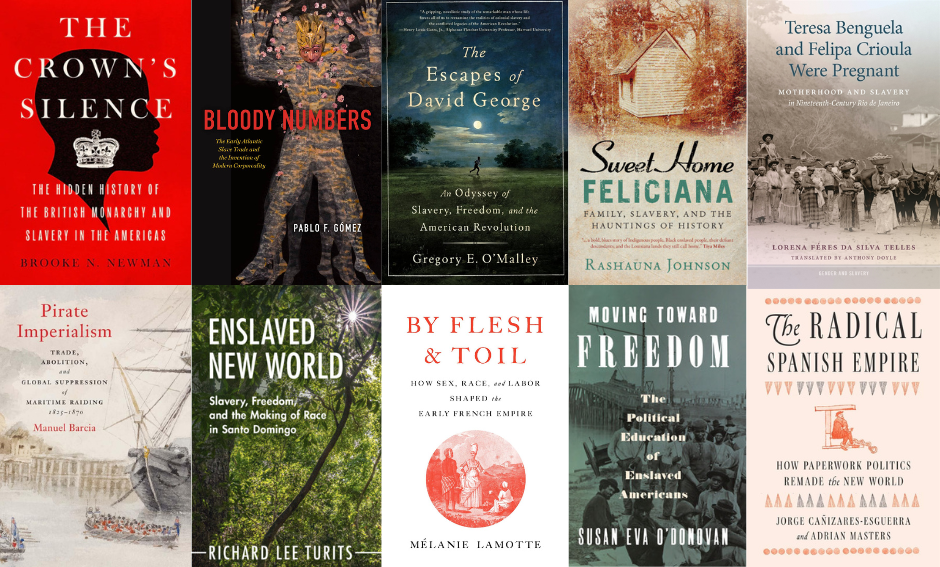
Manuel Barcia. Pirate Imperialism: Trade, Abolition, and Global Suppression of Maritime Raiding, 1825–1870. Yale University Press, 2026.
“Manuel Barcia brilliantly shows how the concept ‘pirate’—the maritime equivalent of ‘barbarian’—served the vast and violent purposes of empire. He also demonstrates that the theme of piracy broadly conceived now attracts the best scholars exploring the biggest issues in global history.”—Marcus Rediker, author of Villains of All Nations: Atlantic Pirates in the Golden Age
Susan Eva Donovan. Moving Toward Freedom : The Political Education of Enslaved Americans. Penguin Press, 2026.
“Susan Eva O’Donovan rightfully implores us to take a new view of American political history by paying the closest attention to what enslaved people were learning, doing, and seeing. Her book is a gripping account of the enslaved people who ‘moved toward freedom,’ as their local, national, and even international travels allowed them, and thus their communities, to get a thorough political education even while living under the lash.”—Henry Louis Gates, Jr., Alphonse Fletcher University Professor, Harvard University
Jorge Cañizares-Esguerra and Adrian Masters. The Radical Spanish Empire: How Paperwork Politics Remade the New World. Harvard University Press, 2026.
“A century of scholarly shibboleths fall with the publication of this book. Advancing their innovative research and synthesizing recent scholarship on the Spanish imperial state, Cañizares-Esguerra and Masters force us to, well, radically rethink our interpretation of the Catholic Empire, to understand it as a territorially enormous experiment in representation and governance. A masterpiece that will change the way scholars study the relationship of Spanish colonialism and political modernity.”—Greg Grandin, author of America, América
Pablo F. Gomez. Bloody Numbers : The Early Atlantic Slave Trade and the Invention of Modern Corporeality. The University of Chicago Press, 2026.
“A pathbreaking work, Body Numbers reveals the historical actions that rendered populations quantifiable. In doing so, Gómez shows that confronting these origins is essential to understanding the violent political, legal, economic, and scientific practices that ascribe numbers to our own bodies.“
Rashauna Johnson. Sweet Home Feliciana : Family, Slavery, and the Hauntings of History. Cambridge University Press, 2026.
“In lyrical prose as moving as song, Sweet Home Feliciana haunts a notorious southern anthem and the troubling nostalgia associated with it. Relying on a wealth of sources and a rare gift of interpretation, historian Rashauna Johnson tells a bold, blues story of Indigenous people, Black enslaved people, their defiant descendants, and the Louisiana lands they still call home. Readers of this book will never see New Orleans or the rural South in the same way again.”—Tiya Miles, author of All That She Carried: The Journey of Ashley’s Sack, a Black Family Keepsake
Mélanie Lamotte. By Flesh and Toil : How Sex, Race, and Labor Shaped the Early French Empire. Cambridge, Massachusetts: Harvard University Press, 2026.
“A truly essential contribution to the history of slavery, gender, and the Atlantic World, Mélanie Lamotte’s work illuminates the connections between sex and race in the lives of all those caught by the legal regimes of the French empire. Grounded in brilliant analysis of difficult and elusive sources, By Flesh and Toil is required reading.” —Jennifer L. Morgan, author of Reckoning with Slavery: Gender, Kinship, and Capitalism in the Early Black Atlantic
Brooke Newman. The Crow Silence: The Hidden History of the British Monarchy and Slavery in the Americas. Mariner, 2026.
“Brooke Newman has written a brave, brilliant, and essential book, telling truths that many will not want to hear. I hope The Crown’s Silence will inspire investigations of other maritime monarchies as we reckon with the still-deadly legacies of human bondage.” —Marcus Rediker, author of The Slave Ship: A Human History
Gregory E. O’Malley. The Escapes of David George : An Odyssey of Slavery, Freedom, and the American Revolution. St. Martin’s Press, 2026.
“Where, on earth, could a Black man in eighteenth-century British America go to be free? As the multiple flights of David George show, the answer was not always clear, but George never abandoned the search. With his award-winning ability to narrate histories of slavery that move between the local and the global, the individual and the community, the material and the spiritual, Gregory O’Malley is an expert guide through David George’s Atlantic world and its reverberations today.” —W. Caleb McDaniel, Pulitzer Prize winning author of Sweet Taste of Liberty
Lorena Fres da Silva Telles. Teresa Benguela and Felipa Crioula Were Pregnant : Motherhood and Slavery in Nineteenth-Century Rio de Janeiro. University of Georgia Press, 2026.
“Telles illuminates the experiences of sexual autonomy, sexual violence, pregnancy, labor, breastfeeding, and the care of enslaved and freed babies in Rio de Janeiro between 1830 and 1888. Teresa Benguela and Felipa Crioula Were Pregnant also details the sorrows and hopes of these enslaved women and illuminates their escapes, strategies of resistance and survival, and the social networks they built to cope with the harsh realities and limitations that slavery imposed on motherhood in nineteenth-century Rio de Janeiro.“
Richard Lee Turits. Enslaved New World : Slavery, Freedom, and the Making of Race in Santo Domingo. Cambridge University Press, 2026.
“Enslaved New World illuminates sixteenth-century Santo Domingo as the site of the Americas’ earliest plantation and slave society and the first place where slavery became limited to people of African descent. Yet Santo Domingo was also home, Turits shows, to widespread continual flight from bondage and an ecology providing escapees with relatively easy refuge. This transformed the colony into a land in which predominantly self-emancipated Black people became the largest population group by the late seventeenth century, 150 years before slavery’s abolition“